Build or Buy: When Custom Software Actually Pays Off in 2026
Joshua Heller · September 23, 2026 · 10 min.
“Can’t you just build that yourself?” We hear this question more often at TAISC these days, now that AI tools like Cursor, Claude Code, or app builders like Lovable make it possible to click together an internal Trello board, a dashboard, or a small CRM in a few hours, with zero development background. That’s impressive. It’s also the wrong first question.
The right question isn’t “can I build this” but: does it actually pay off, and who owns the data it produces? This post walks through a staged model we use at TAISC to work through exactly this decision with clients, backed by current research on software purchase regret, lock-in costs, and data sovereignty in the German Mittelstand and beyond.
Why “can I build this” is the wrong starting question
Clicking together an internal tool in a few hours, without ever having built software before, sounds like a productivity miracle. The uncomfortable follow-up question always arrives eventually: how do you keep developing this in six or twelve months, once your process changes? Who maintains it once the person who built it actually has other work to do? App builders like Lovable are well suited for an early prototype or to make a good impression, but rarely for a system your business depends on long-term.
The actual decision hinges on four questions that have nothing to do with whether something is technically buildable:
- Lock-in and dependencies: How easily can you get out of a system again once it stops fitting?
- ROI and prioritization: Is the problem big enough to justify ongoing development time?
- Data ownership: Who actually owns the data your operations generate, technically and contractually?
- Privacy and security: Who is liable when something goes wrong in a self-built tool?
That these questions are becoming more important, not less, shows up in three developments that are all converging in 2026 at once.
Three shifts changing the build-or-buy math in 2026
SaaS is getting more expensive, not cheaper. According to SaaS spend analysts like Zylo and Cledara, subscription software prices rose roughly 8-9% on average year-over-year in 2026, with more aggressive vendors and AI-feature bundles pushing well into double digits. One reason: new-customer growth has stalled for many SaaS vendors, while existing customers are locked in through data and workflow dependencies, which makes price increases easier to push through.
The EU Data Act has turned lock-in into a legal issue since September 2025, not just a gut feeling. Since September 12, 2025, the EU Data Act has required cloud and SaaS providers (Articles 23-31) to make switching to another provider, or back to an in-house system, noticeably easier: open interfaces, a maximum two-month notice period, and a transition period of at most 30 days. Until January 12, 2027, providers may still charge cost-covering switching fees; after that, regular switches must be entirely free of charge. The law exists because lock-in has been a real, expensive problem, not a theoretical one.
Data sovereignty has become a top priority for the German Mittelstand. A 2026 study by otris software, Evergreen Media, and Splendid Research surveying 518 IT and legal decision-makers at mid-sized and large German companies found that two-thirds now rank data sovereignty and regulatory compliance above innovation speed or cost. More than half require an EU-regulated provider or dedicated servers from their cloud vendor; plain “EU hosting” satisfies only a quarter. Bitkom’s 2026 Cloud Report adds a sobering data point: 91% of German companies would prefer to work with a German cloud provider, yet 71% use an American one anyway, mostly for lack of alternatives with comparable functionality.
None of these three trends flips the classic buy logic (“SaaS is always cheaper and lower-risk than building it yourself”) on its head, but they meaningfully shift the balance.
The staged model: don’t build everything, don’t buy everything either
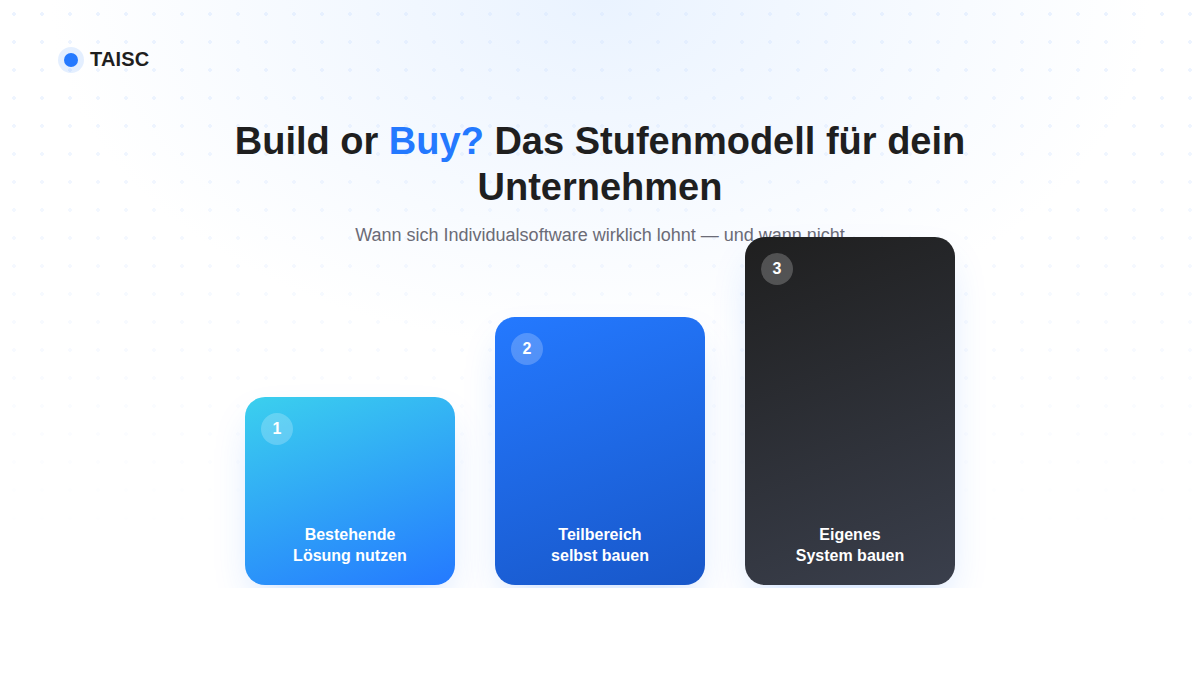
Instead of “build everything” or “buy everything,” a staged approach has proven itself across our projects, structurally similar to what Gartner describes in its Pace-Layered Application Strategy: systems differ by how often they change and how much they actually differentiate a business, not by how important they sound.
| Stage | Approach | Typical example | When it fits |
|---|---|---|---|
| 1. Extend | Use an existing solution, automate parts of it (e.g. with n8n) | Standard CRM plus automation for quotes and follow-ups | The process is industry-standard, off-the-shelf software covers 80%+ |
| 2. Build a part | A custom dashboard or tool that taps into existing systems (CRM, ERP, invoicing) | Role-based order dashboard pulling from multiple interfaces | One sub-process is genuinely unique, the rest stays standard |
| 3. Build fully in-house | Own database, auth, frontend, backend as the system of record | Custom order and customer management for a niche industry | The process, customers, or industry are so specific that no fitting solution exists on the market |
The break between stage 1 and stage 2 matters most: a potential-analysis before development, one that properly weighs lock-in risk, ROI, and the data model, costs a fraction of what a wrongly started custom-build project costs. A recent Gartner survey shows exactly how expensive a rushed decision gets, in either direction.
What purchase-regret research shows, and why it applies to DIY builds too
Gartner’s “2024 Tech Trends” survey of more than 3,400 software buyers across nine countries found that 60% of all buyers regret their software purchase at least partially in hindsight, rising to 68% among fast-growing companies. The leading causes are higher-than-expected total cost of ownership (33%) and slow or overly complex implementation (32%). Notably, the companies most confident going into the purchase process are the ones most likely to regret it later.
This number is often cited as an argument for “then let’s just build it ourselves.” That’s too quick. The same mechanisms, underestimated total cost and underestimated effort for the actual rollout, apply just as much to self-built tools, except nobody writes an invoice that makes the real cost visible. An internal tool built with AI over a weekend still creates maintenance load; it just hides inside the team’s time over the following months instead of showing up on a bill. We’ve seen this play out with clients whose purchased software was never actually adopted, something we broke down with concrete adoption numbers in our post on unused software. The underlying problem is structurally the same, whether it was bought or built.
Where buying off the shelf is still the better call
Not every system is a good candidate for stage 2 or 3. The difference comes down to how standardized the underlying data is:
- CRMs are genuinely replaceable. Data structures are comparatively simple and similar across industries, and many standard features go unused anyway while still being paid for. Stage 1 (automation on top) or a lean, self-built replacement often pays off faster than expected.
- ERPs usually aren’t. Complex, industry-specific logic, many integrations, and decades of accumulated niche knowledge live inside established ERP systems. Competing against an established vendor here is rarely the best use of development budget, unless one specific sub-process is genuinely unique (in which case: stage 2, not stage 3).
We worked through exactly this trade-off, when an established system provides a better data foundation than a rebuild, for a heat-pump installer in the trades sector, with a real timeline and feature scope, in Custom Software for Trades Businesses.
How we approach this with clients at TAISC
In projects where we work through the build-or-buy question together with clients, the process looks like this:
- A potential-analysis before any commitment. We map the existing process before a single line of code gets written, weighing lock-in risk, three years of running SaaS cost, and stage-2 effort against each other.
- Start at the lowest stage that makes sense. We never recommend jumping straight to stage 3. The path there almost always runs through stages 1 and 2, using real usage data as the basis for the next decision.
- Data ownership goes into the contract up front, not as an afterthought. Where data lives, who has export rights, and what happens on termination gets clarified before the first sprint, not when it’s time to switch providers.
- Maintenance gets priced in, not pushed aside. A self-built tool without planned upkeep is next year’s shelfware. We cover this in more depth in our foundational article on AI Agents for Businesses (German), where we look at governance beyond the initial build.
If you don’t want to or can’t run development permanently in-house, a specialized partner such as an AI agency (German) is usually more cost-effective than growing your own dev team around a single internal tool.
Frequently Asked Questions
Frequently Asked Questions
Is building it yourself with AI tools like Lovable automatically cheaper than SaaS?
Not automatically. The visible build cost is often low, but maintenance, ongoing development, and hardening rarely show up in that same calculation. An AI-built prototype is a different thing from a production system your business depends on.
What does the EU Data Act actually change for companies using SaaS?
Since September 12, 2025, cloud and SaaS providers must make it easier to switch to another provider or back to an in-house system: open interfaces, a maximum two-month notice period, and a transition period of at most 30 days. Cost-covering switching fees are still allowed until early 2027, after which regular switches must be entirely free.
When does full in-house development (stage 3) actually make sense?
Only when the process, customers, or industry are specific enough that no fitting solution exists on the market, and the process is important enough to justify ongoing development and maintenance cost. For most standard processes (CRM, accounting, standard ERP functions), that's rarely the case.
Does TAISC also help with the potential-analysis if a SaaS solution ends up being the better choice?
Yes, explicitly. Our recommendation follows what actually makes economic and compliance sense for your business, not what generates the most project volume for us as a development partner. Sometimes the analysis concludes that stage 1 is entirely sufficient.
Conclusion
Build or buy isn’t a one-time architecture decision anymore in 2026, it’s a question worth revisiting regularly as SaaS prices climb, the EU Data Act reshapes switching costs, and data sovereignty awareness grows across the Mittelstand. The staged model of extend, partial build, and full build avoids the two most expensive mistakes: building everything yourself too early and creating a maintenance burden nobody priced in, or sticking with a SaaS solution too long that never quite fits the process while accumulating years of lock-in cost.
Not sure which stage your next project should start at? Book a free intro call, and we’ll work through what actually pays off for your process.
Your direct line to our AI specialists
Book a free consultation