Will AI Soon Replace the Clean Code Developer?
Joshua Heller · April 25, 2025 · 11 min.
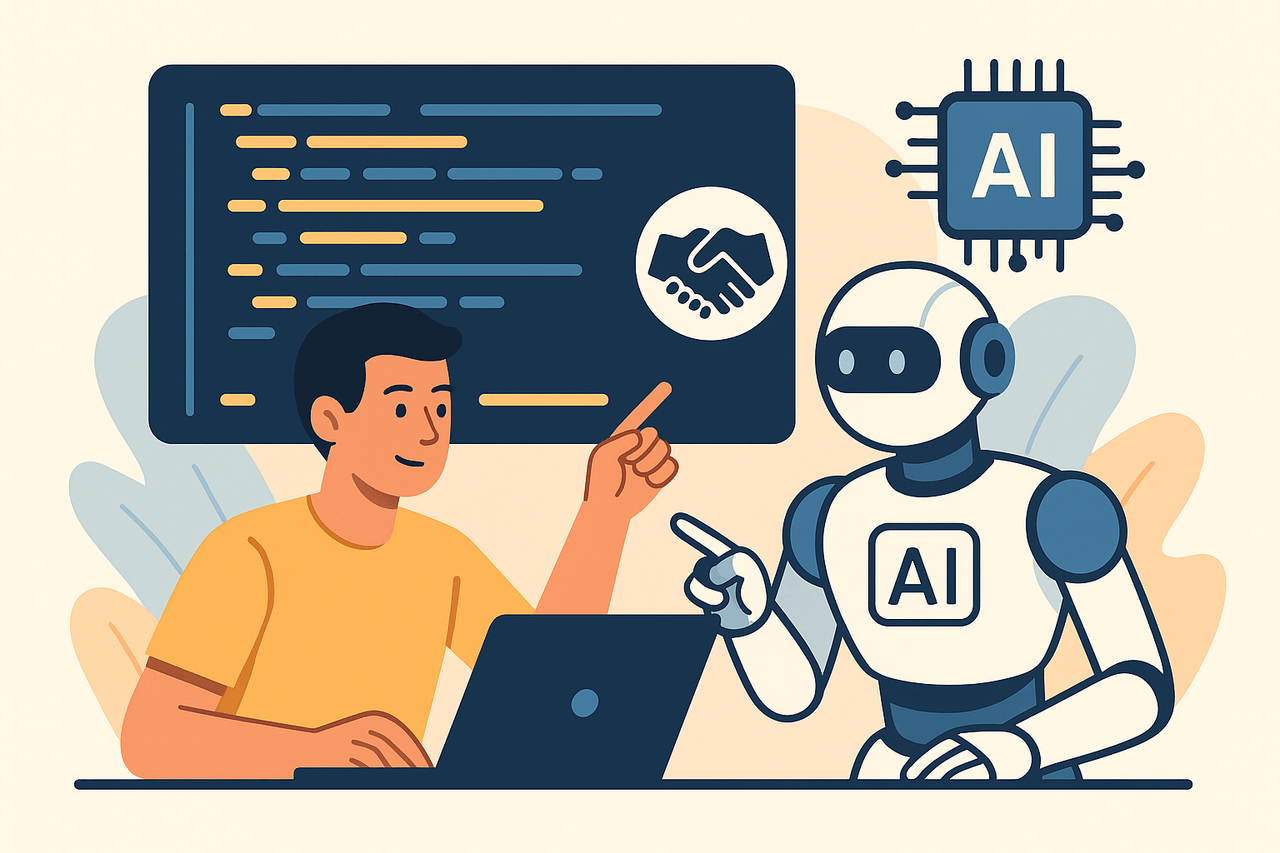
Software development stands at a turning point. Artificial intelligence (AI) has experienced a rapid rise in recent years and already influences many areas of the industry today. From automated code completion to debugging: AI tools like GitHub Copilot, ChatGPT, CursorAI, or tailored solutions support developers in their daily tasks. These advances, however, raise a central question: Will AI eventually make the clean code developer obsolete?
At first glance, one might think this development is within reach. After all, AI models can now handle complex tasks in fractions of a second and generate seemingly flawless code. But is that really enough to take over the role of an experienced software engineer?
The thesis: AI doesn’t replace the developer, it complements them
The short answer is: probably not. And there are good reasons for that. Software development, especially in B2B industrial projects, is far more than writing “clean code.” It is a complex process that requires deep domain knowledge, architectural understanding, and above all experience. AI cannot offer these capabilities today, and perhaps will not be able to in the foreseeable future either.
Nevertheless, this does not mean that AI has no place in software development. Quite the opposite: it is a powerful tool that helps developers work more efficiently and further develop their skills. The key therefore lies not in replacement, but in complementation.
In this blog post, we take a closer look at why AI does not replace the clean code developer, how AI can support software development, and why best practices such as clean code continue to play a central role in the AI era. In doing so, we also show how the targeted use of AI tools can improve both the learning process and code quality.
1. The Complexity of B2B Software Projects
More than just clean code
At first glance, it may seem as though developing software is primarily about writing functioning and “clean” code. But precisely with complex B2B software projects, this notion falls short. In industry, far-reaching requirements lie behind every line of code, requirements that go well beyond syntax and code quality.
An example: imagine a company develops a tailored ERP system (Enterprise Resource Planning) for the manufacturing industry. Here it is not only about the code being error-free and maintainable. Developers must also bring deep domain knowledge about production processes, logistics, and business workflows in order to create a solution that actually works in the real world.
In addition, a solid architectural understanding is indispensable. Software architecture determines how flexible, scalable, and sustainable a solution is. Decisions about whether microservices or monolithic architectures are used, how databases are structured, or how APIs need to be built often have long-term consequences. These decisions require experience, creativity, and a clear vision, something that AI models (still) cannot deliver.
The role of experience
Another central element: experience. In complex projects, it is often not the technical implementation itself that represents the greatest challenge. Rather, it is about choosing the right one from a multitude of solution approaches, and doing so while taking into account time, budget, resources, and the specific requirements of the industry.
Experienced developers bring something here that no AI has been able to replace so far: human judgment. Through years of working on various projects, they have learned to recognize patterns, assess risks, and make pragmatic decisions. They know that software development rarely proceeds in a linear fashion and how important it is to be able to respond flexibly to unforeseen challenges.
A vivid example: imagine a customer wants to develop software for the real-time analysis of production data. An experienced developer knows from earlier projects that a poorly planned data pipeline could lead to performance problems. She therefore decides to invest in load tests early on and to choose an architectural approach that allows for future extensions. No AI tool can take over this kind of foresight, it lacks the context and the ability to draw conclusions from non-technical factors.
Human expertise remains irreplaceable
In summary: clean code is undoubtedly important, but it is only one building block in the complex world of B2B software development. Without deep domain knowledge, a well-thought-out architectural foundation, and the wisdom that grows out of experience, projects remain vulnerable to errors that are expensive to correct later.
This is exactly where the strength of the human developer becomes apparent: through their holistic approach and their ability to understand and connect different aspects of a project, they create sustainable solutions that meet the requirements of the real world. AI can be a valuable support in this equation, but the leading role is still played by the human.
2. The Support Provided by AI in Software Development
Current capabilities of AI
AI has revolutionized software development in recent years. Tools like GitHub Copilot, ChatGPT, CursorAI, Codeium, Claude, or other code analysis tools offer developers powerful support today that was unthinkable just a few years ago. The practical benefit of AI is especially evident in the following areas:
- Code completion: AI-powered tools can make code suggestions while writing that take into account not only syntax and structure, but also the context of the current project. This significantly speeds up repetitive tasks.
- Debugging: The automated analysis of code makes it possible to detect potential bugs or security vulnerabilities early. Some tools can even make suggestions for fixing these problems.
- Code refactoring: AI systems can detect inefficient or unclear code and provide improvement suggestions oriented toward best practices, naming conventions, or clean code principles.
- Generating boilerplate code: Frequently recurring code patterns can be generated automatically by AI tools, allowing developers to concentrate on more complex tasks.
- Documentation and explanations: Especially with poorly documented code, AI can help analyze functions and describe their meaning in simple words.
These capabilities save time, reduce errors, and create room for creative work. Yet despite all these advances, there are clear limits.
Limits of AI
As impressive as the current capabilities of AI in software development are, they are no substitute for the creative and holistic approach of an experienced developer. Why? There are three central challenges:
- Lack of understanding for context and nuance:
AI models work on the basis of the data they were trained with. This means they can interpret code and make suggestions, but they have no deeper understanding of the context of a specific project. An AI does not know, for example, which business or strategic decisions lie behind a particular architecture.
Example: an AI tool might suggest simplifying a function to save code. In doing so, it could overlook that this function was deliberately designed this way to facilitate future extensions. Such decisions depend on nuances that an experienced developer recognizes based on their understanding of the project, but an AI does not.
- No holistic thinking:
Software development is more than solving technical problems. It requires creative and strategic thinking, especially when planning architectures, assessing risks, and considering the long-term scalability of a solution. Here AI quickly reaches its limits. It can make suggestions, but it cannot develop a vision.
- Lack of responsibility and judgment:
A decisive difference between human and machine lies in the ability to take responsibility. Developers make decisions not only based on technical considerations, but also on ethical and business aspects. AI cannot take responsibility and cannot make ethical trade-offs, for example when deciding how sensitive data should be processed.
Support, not replacement
AI undoubtedly has the potential to make developers more productive and to take over routine tasks for them. Yet in complex projects, the human remains irreplaceable. Only experienced developers can bridge the gap between technology, business goals, and ethical considerations.
The true strength lies in the combination: when developers use AI tools in a targeted way to complement their work, they can leverage the best of both worlds. This leaves more time and space for creativity, strategic thinking, and the development of sustainable solutions, all the things that make up the essence of software development.
3. A Personal Learning Journey with Clean Code and AI
The topic of clean code
Clean code is more than just a collection of rules, it is a mindset that fundamentally changes software development. The focus is on writing code in such a way that it is readable, maintainable, production-efficient, and extensible. For many developers, however, getting started with clean code is a challenge, and that was no different for me.
When I began to engage more intensively with clean code, I quickly noticed how big the difference is between “functioning” code and “clean” code. Functioning code does what it is supposed to do, but clean code does it in a way that remains understandable and maintainable even after months or years of further development. This shift in thinking is a real learning curve, especially when you previously had little contact with clean code principles.
On top of that came my personal situation: as a part-time developer, the time I can invest in continued education is limited. Topics like meaningful naming conventions, avoiding code duplication (DRY), or writing clearly structured functions (IOSP and SRP) require practice and time, both of which are scarce when you don’t program full-time. But this is exactly where AI came into play and made a decisive difference.
Developing the Clean Code Agent
The decisive turning point came when, together with my colleagues, true clean code experts, I worked on a tailored tool: the Clean Code Agent. Based on CustomGPT, we developed an AI agent specifically tailored to the principles of clean code.
The collaboration with experienced developers from generic.de AG was essential here. They contributed their solid knowledge about clean code, while I concentrated on the technical implementation and the training of the model. The goal was clear: to create an AI tool that acts as a tutor, not only to find errors in the code, but also to explain the underlying principles.
The result was impressive. The Clean Code Agent now helps me in my learning process by:
- Giving feedback on code snippets: the agent detects unclean code and suggests improvements based on clean code principles.
- Explaining concepts: it provides easy-to-understand explanations of principles like “Single Responsibility” (SRP), “Don’t Repeat Yourself” (DRY), or “KISS” (Keep It Simple, Stupid).
- Enabling practical learning: instead of just providing solutions, the agent encourages you to follow and apply the suggestions step by step.
The beauty of it: the Clean Code Agent is far more than just a refactoring tool. It forces me to learn actively, instead of simply pushing buttons. Working with the agent has accelerated my learning process without having to do without the support of experienced colleagues.
Learning with AI, an unbeatable combination
The Clean Code Agent has shown me how AI can be used in a targeted way to support the learning process. It is not about outsourcing work, but about creating a tool that helps developers make better decisions and write sustainable code.
The journey toward a better understanding of clean code is certainly challenging, but thanks to modern AI tools also incredibly rewarding. For me, the agent is a game-changer that eases the entry while at the same time fostering the ambition to continuously develop further. Because that is exactly the core of clean code, and of good software development overall.
4. The Clean Code Agent as a Tutor
Functions and benefits
The Clean Code Agent is not just a tool, but a true tutor for developers who want to delve deeper into the topic of clean code. Its main task is to foster an understanding of clean code while providing practical support. But how exactly does that work?
- Feedback on code snippets:
- The agent analyzes the code you give it and detects typical problem areas that might violate clean code principles. For example, it points out unclear function names, unnecessary code duplication, or overloaded methods. But instead of just listing errors, it goes a step further: it provides concrete improvement suggestions that you can follow and implement directly.
- Explanation of principles:
- One of the greatest advantages of the agent is its ability to explain not only “what” should be improved, but also “why.” When the agent recommends, for example, reducing the size of a function, it simultaneously explains the principle of “Single Responsibility” and why it improves the readability and maintainability of your code. This combination of analysis and didactics makes it an invaluable learning companion.
- Practical learning:
- In contrast to classic teaching materials like books or courses, the Clean Code Agent enables interactive learning. You work directly on your own code and receive feedback in real time. This makes learning not only more efficient, but also more relevant, since you immediately recognize how the improvement suggestions affect your work.
Learning strategy
The true value of the Clean Code Agent, however, lies not only in its functions, but also in the way you use it. A deliberate learning strategy is decisive for getting the most out of this tool.
Going through improvements yourself
One of the most important decisions I made was not to simply let the agent perform refactoring automatically. It would be tempting to let the agent implement every improvement suggestion directly, after all, that saves time. But I quickly realized that I learn more when I implement the suggestions step by step myself.
By carrying out the changes manually, I understand the underlying principles much better. Why should I split a method into several smaller ones? Why should integration and operation not be in one function? These insights come not from mere observation, but from active application.
The added value of active learning
Passive learning, that is, simply watching an AI improve my code, may seem efficient in the short term, but in the long term it brings little. The real added value lies in active learning: in the process of recognizing the connections yourself, understanding the reasons behind the suggestions, and thereby developing a deeper understanding of clean code.
This approach has not only helped me improve my skills, but also strengthened my confidence in my own decisions as a developer. I have learned to critically question the suggestions of the Clean Code Agent, to place them in the context of my project, and to adapt them where necessary.
A tutor that encourages and challenges
The Clean Code Agent is more than just a tool for code optimization, it is a tutor that accompanies you on your learning journey. Its ability to give feedback, explain principles, and enable practical learning makes it an indispensable partner for everyone who wants to engage with clean code.
But as with every tutor, success ultimately lies with you. The agent provides the tools and the knowledge, but it is you who must actively apply them. This combination of support and personal initiative is the key not only to writing better code, but also to becoming a better developer.
5. The Future of Clean Code in the AI Era
The importance of best practices
Even in an era in which AI takes on an ever greater influence on software development, clean code remains an indispensable foundation. Why? Because clean and clear code practices are the basis for every successful software solution, regardless of whether it is developed by humans, AI, or a combination of both.
AI tools can certainly help us write and optimize code, but in doing so they only follow the patterns they have learned from existing data. If the underlying code is incomprehensible or poorly structured, this inevitably leads to inefficient or hard-to-maintain solutions. This means: only when developers continue to apply best practices like clean code can AI-powered systems unfold their full potential.
Clean code is therefore far more than a “nice-to-have,” it remains an indispensable component of modern software development. Clean code is not only easier for humans to understand and maintain, but also easier for AI systems to analyze and improve. In a way, clean code forms the language that connects human and machine.
The symbiosis of human and machine
In the future, the true strength will not lie in whether developers or AI write the better code, but in how both can work together. This symbiosis of human and machine opens up exciting possibilities:
- AI as a tool for increasing efficiency:
- AI can take over repetitive tasks that cost time and resources. Examples are automated code completion, finding errors, or generating boilerplate code. This leaves developers more time to concentrate on the truly challenging aspects of their work, such as designing architectures, solving complex problems, or coordinating with stakeholders.
- Preserving human expertise:
- A frequently voiced doubt is that the increasing use of AI could lead to developers losing their skills. But this does not have to be the case. On the contrary: when AI is regarded as a complement rather than a replacement, developers can purposefully expand their expertise. They use AI as a sparring partner to test new ideas, weigh alternatives, or refine best practices.
- Focus on the big challenges:
- By having AI take over everyday tasks, developers can direct their energy toward the truly complex and creative aspects of software development. These include, for example, developing innovative features, improving the user experience, or solving challenges that go far beyond writing code.
The future belongs to collaboration
Clean code will lose none of its importance in the AI era either, on the contrary. Precisely because AI tools depend on clear and structured code, clean code remains the foundation for efficient and sustainable software development.
The symbiosis of human and machine has the potential to lead software development into a new era: an era in which developers become more productive and creative through the targeted use of AI. The key role remains with the human, as a strategic thinker, creative problem-solver, and guardian of best practices.
The future of software development is therefore not human or machine, but human with machine. And that is an optimistic perspective that shows how much potential lies in this collaboration.
Conclusion: Human and AI, a Strong Team for the Future
Summary of the key messages
Artificial intelligence is changing software development, but not in the way some fear. It does not replace the experienced developer, but supports them. AI tools like the Clean Code Agent impressively demonstrate how human and machine can work together to create better and more efficient solutions.
But despite all the advances, one thing remains clear: the key to successful software development continues to lie in human expertise. Experience, domain knowledge, and a deep understanding of clean code principles are indispensable for developing sustainable and high-quality software. AI can certainly take over repetitive tasks and accelerate the learning process, but it will never have the ability to act creatively, strategically, or ethically. These qualities remain reserved for the human.
Outlook
The future of software development belongs to the collaboration of human and machine. AI will increasingly relieve us of routine tasks, so that we can concentrate our time and energy on the truly challenging aspects of software development. This symbiosis opens up new possibilities to make software development more creative, more productive, and more sustainable.
To realize this potential, it is decisive to remain open to change. Integrating modern tools and continuously educating yourself is the key to succeeding in an AI-powered world. AI should not be seen as a threat, but as a tool that supports developers in taking their skills to the next level.
Closing words
Clean code, experience, and domain knowledge are the foundation, AI is the accelerator. If we manage to combine the strengths of both worlds, an exciting future lies ahead of us. And isn’t that a great perspective?
Additional Resources
For everyone who wants to dive deeper into the topic of clean code and the use of AI, here are a few helpful resources:
Clean Code Agent
Test the Clean Code Agent yourself and experience how AI can support you in learning and applying clean code principles.
Open-Source Repository: Web Summarizer
Take a look at the open-source project “Web Summarizer,” which I worked on with the Clean Code Agent. It could be an exciting source of inspiration for your own learning or your projects.
Have fun exploring and learning!
The AI Software Company supports small and mid-sized software companies in the DACH region in making their development processes more efficient, faster, and future-proof with AI. Our “AI-ready in 6 weeks” program offers practical training and individual consulting, from tools for your individual tech stack, through clean code, templates for employee guidelines and customer agreements, all the way to legal questions.
Curious how you can use AI meaningfully in your software team? Sign up for our newsletter and receive valuable tips, insights, and updates!
Your direct line to our AI specialists
Book a free consultation